Right now, this second, your body is taking in something close to 11 million pieces of information per second.
The pressure of the chair. The temperature of the air on your left arm. Every sound in the building. The weight of your own tongue in your mouth.
Your conscious mind can handle about 40 to 50 of those.
That’s not a typo. Eleven million in. Forty get through. (ScienceDirect: Reticular Activating System)
So the obvious question — and it took me an embarrassingly long time to think of it — is:
Who decides which forty?
Meet the bouncer
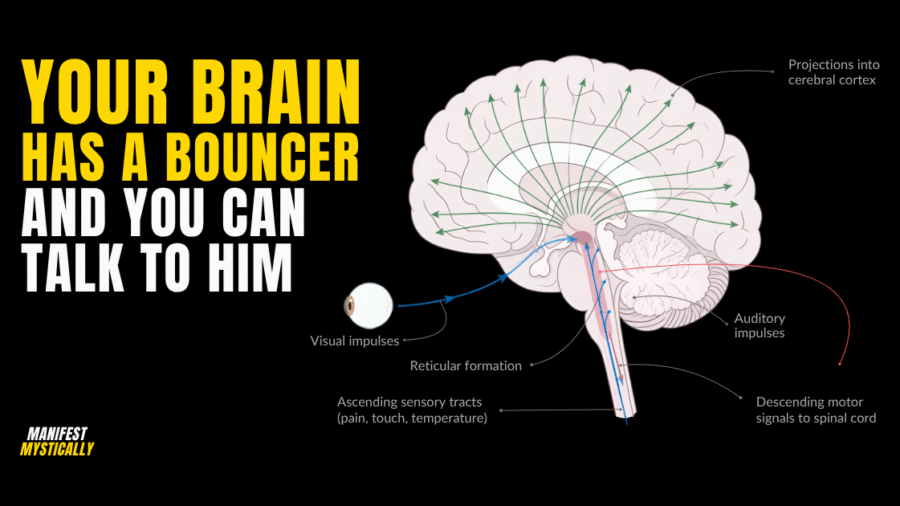
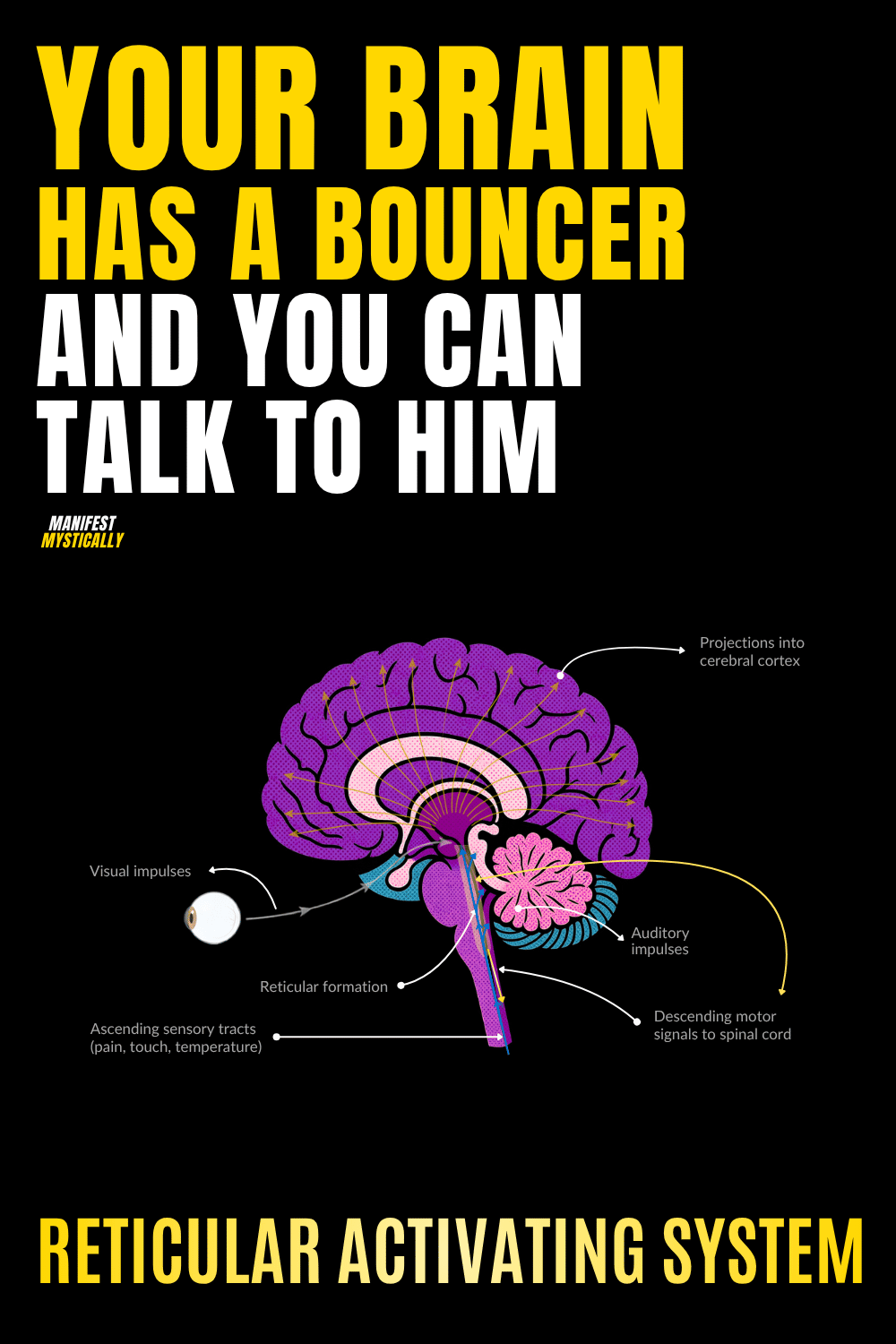
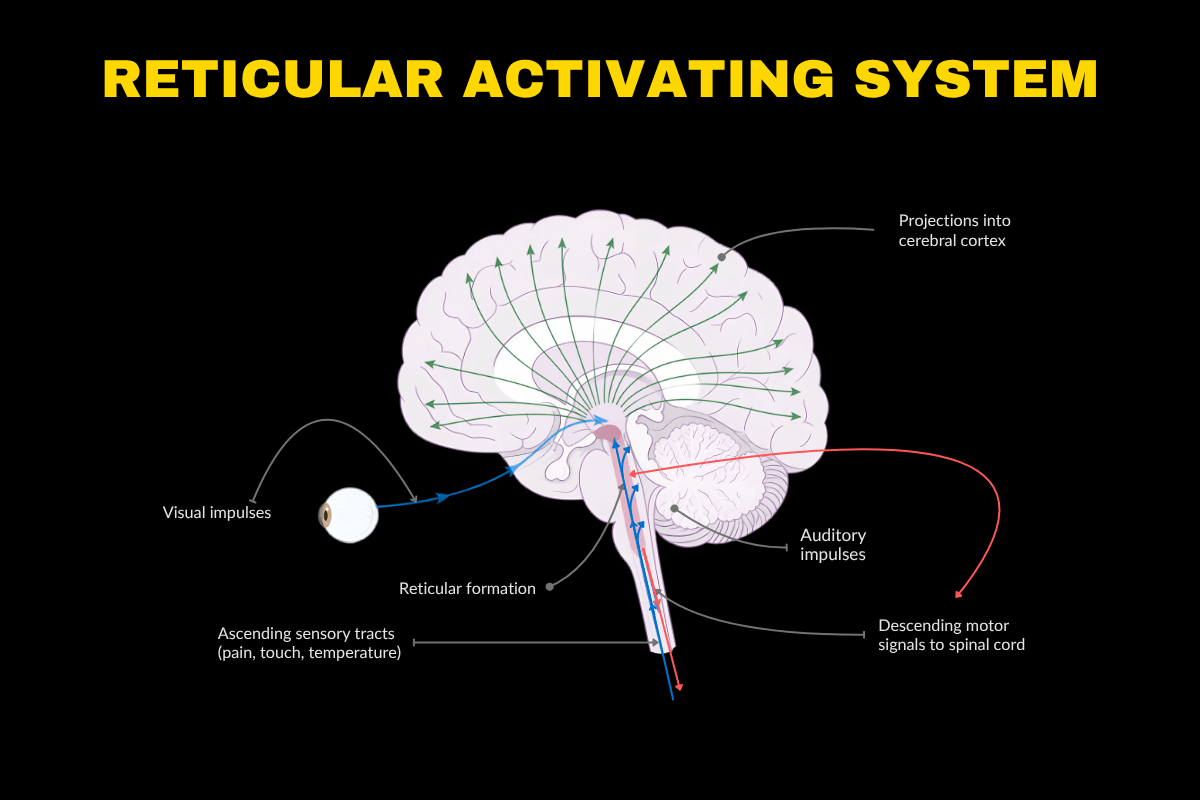
There’s a bundle of neurons at the base of your brain, right where your spine meets your skull. It’s called the reticular activating system. RAS for short.
Think of a nightclub with a line around the block and a bouncer at the door working from a list.
Eleven million people want in. He lets in forty. Everyone else goes home, and — this is the important bit — you never find out they were there.
You don’t experience the RAS filtering things out. You just experience a world that seems to contain only forty things. It feels complete. It isn’t remotely complete.
You’ve been living inside a heavily edited version of reality your entire life. Everyone has.
💡 REMEMBER THIS
You are not seeing the world. You are seeing your brain’s shortlist.
The list the bouncer works from
Now. Where does he get the list?
Mostly from you. From what you’ve told him — through repetition and attention — actually matters.
He’s watching for four things:
1. Danger. Non-negotiable, always on. A sound in your house at 2 a.m. gets through instantly.
2. Your name. This is why you can be in a loud room, not following any conversation, and still snap to attention the second someone three tables over says your name. Your brain was processing every one of those conversations the whole time. It just wasn’t showing you.
3. What you need right now. Hungry people notice restaurants. That’s the RAS.
4. What you’ve told it is important. And this is the one that changes things.
The red car thing
You know this one already, you just didn’t know it had a name.
Someone buys a blue Honda. Within a week they say, “It’s the strangest thing, there are blue Hondas everywhere now.”
There aren’t. There were always that many blue Hondas. What changed is that “blue Honda” got added to the list, and the bouncer started letting them through.
Psychologists call it the frequency illusion. And it is genuinely one of the most reliable, well-documented things about human perception.
Here’s what I want you to sit with, though, because this is where it stops being a fun fact:
It works on everything. Not just cars.
It works on evidence that people are unkind. It works on evidence that you always get overlooked. It works on evidence that nothing ever goes your way.
If you have spent fifteen years telling your brain that “nothing ever works out for me” is an important pattern to watch for — your bouncer has been collecting proof for fifteen years. Diligently. Faithfully. He thinks he’s helping you.
And every single piece of proof he brought you was real. That’s what makes it so convincing.
(This connects directly to something else your brain does — it weights bad information more heavily than good. I wrote about that here, and the two together explain a great deal.)
So how do you change the list?
Not by shouting at yourself in the mirror. That mostly doesn’t work, and there’s a good reason why.
You change it the same way it got built in the first place: specific, repeated attention.
Three things that actually move it:
Be ridiculously specific. “I want abundance” gives the bouncer nothing. He can’t scan for a mood. “I’m looking for someone who needs weekend help with their mother” — now he has a description. Now he can work.
Ask questions instead of making statements. Your brain treats a question as an open assignment and keeps working on it in the background. There’s a reason answers arrive in the shower.
Try: “What’s one thing I could do this week that I haven’t tried?” Ask it every morning. Don’t force an answer. Watch what surfaces by Thursday.
Look for counter-evidence on purpose. If your list currently says “people take advantage of me,” you have to hand the bouncer a competing instruction. At the end of the day, name one thing — one — that someone did for you that they didn’t have to. It’ll feel forced for about two weeks. Then it stops feeling forced, and that’s the list changing.
💡 REMEMBER THIS
You cannot control what exists. You have real influence over what you’re shown.
Where the science stops
I want to be straight with you, because this is where a lot of writing about the RAS quietly goes off the rails.
What’s solidly established:
Your brain filters an enormous amount of sensory information down to a tiny conscious stream. The reticular activating system is genuinely involved in arousal and attention. Directing attention changes what you perceive and what you remember. All of this is real, mainstream neuroscience.
What is not established:
That your RAS sends signals into the universe. That noticing things causes them to exist. That the filter creates rather than selects.
The RAS helps you notice what’s relevant and prepare to act. It does not manufacture reality out of thought. The actual change still requires you to move. (Rowan Center for Behavioral Medicine)
Anyone selling you the stronger version is selling you something.
And now the part I won’t pretend to settle.
Here is what science genuinely cannot tell you: why the right thing shows up at the right moment.
Neuroscience explains the mechanism — the bouncer, the list, the noticing. It’s completely silent on whether anything is arranging what walks past the door.
Some people read all this and conclude it’s just perception, and that’s the whole story. Others read the exact same facts and see something older at work — that we were made with a door, and that what arrives at it isn’t always random.
I’m not going to tell you which of those is right. Nobody can. What I’ll tell you is that understanding the mechanism doesn’t shrink the mystery. For me it did the opposite. There’s something remarkable about being built with a filter you can speak to.
What you believe is standing on the other side of that door — that part’s yours.
READ THIS NEXT
→ Going deeper: Why Your Brain Fights the Life You Want
You’ve told the bouncer what to look for. So why does everything in you still resist when it shows up?
→ Going sideways: Angel Numbers, Explained Honestly
If your brain shows you what you’ve flagged — what’s really going on when you keep seeing 333? The answer is more interesting than either side admits.
Written by Manifest Mystically Team. About →
Manifest Mystically shares neuroscience research and spiritual reflection for educational purposes. Nothing here is medical, psychological, or financial advice.
